
Joining the 2026 Asian Apiculture Association Conference
A few days ago, I joined the 18th Asian Apiculture Association (AAA) Conference on October 16 and 17, 2026. And I’d like to share what I learned there about native bees.
One of the presenters shared the following map:
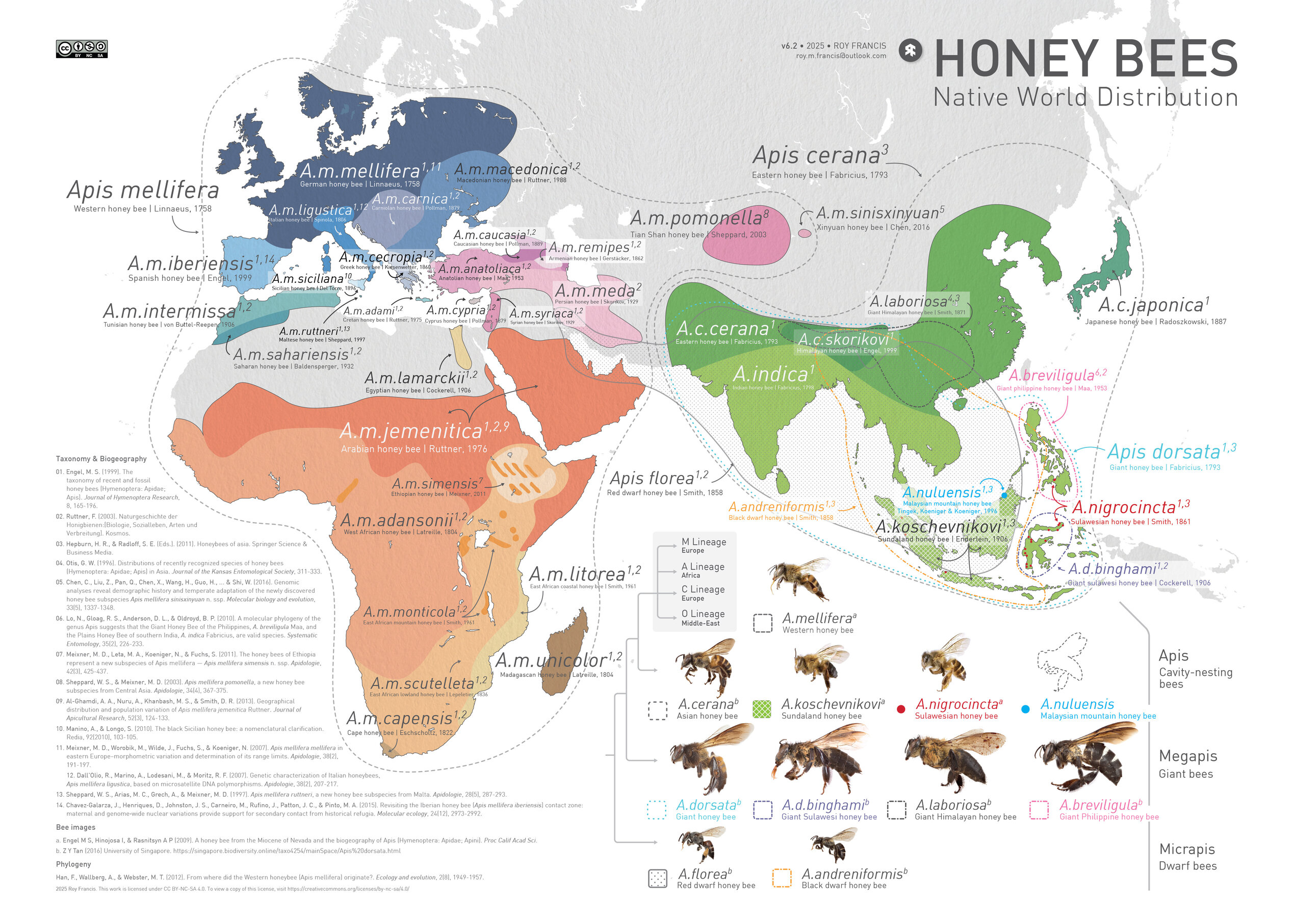
It’s a wonderful map created by Roy Francis, which shows the native range of every species and subspecies of honey bees. For context, I am in Japan raising Japanese honey bees (Apis cerana japonica).
Because of its productivity, most beekeeping in the world relies on breeds of the Italian honey bee (Apis mellifera ligustica), which is only one of the many subspecies of the western honey bee found across Europe, Africa, the Middle East and Central Asia. Japan is no exception: a study from Kyoto Sangyo University found that almost all western honey bees kept in Japan are of Italian origin. The map shows how many more honey bees there are in Asia alone: the eastern honey bee, the giant honey bees that hang a single comb in the open, and the tiny dwarf honey bees. The Japanese honey bee is the subspecies of the eastern honey bee at the far northeast corner of the map.
Here are some species and subspecies:
| Latin name | English name |
|---|---|
| Subgenus Apis | Cavity-nesting honey bees |
| Apis mellifera | Western honey bee |
| A. m. mellifera | Black bee |
| A. m. ligustica | Italian honey bee |
| A. m. jemenitica | Arabian honey bee |
| Apis cerana | Eastern honey bee |
| A. c. cerana | Eastern honey bee (nominate subspecies) |
| A. c. indica | Indian honey bee (Apis indica on the map) |
| A. c. skorikovi | Himalayan honey bee |
| A. c. japonica | Japanese honey bee |
| Subgenus Megapis | Giant honey bees |
| Apis dorsata | Giant honey bee |
| Apis laboriosa | Giant Himalayan honey bee |
| Subgenus Micrapis | Dwarf honey bees |
| Apis florea | Red dwarf honey bee |
| Apis andreniformis | Black dwarf honey bee |
A. m. mellifera is the dark western honey bee, which is why it is called the black bee in English. Across most of its native range in northern and western Europe, it has been replaced by imported bees such as the Italian honey bee, so even among western honey bees, native bees are in danger. Unfortunately, beekeepers are incentivized to use the most productive bees, at the expense of the native bees.
The same thing is happening in Asia. A poster at the conference by Syed Mohammed Mainul Anwar from the Alwan Honey Museum & Research Centre, about beekeeping in Bangladesh, put it in a way I liked: Apis cerana honey is better in quality, while Apis mellifera honey is better in quantity.
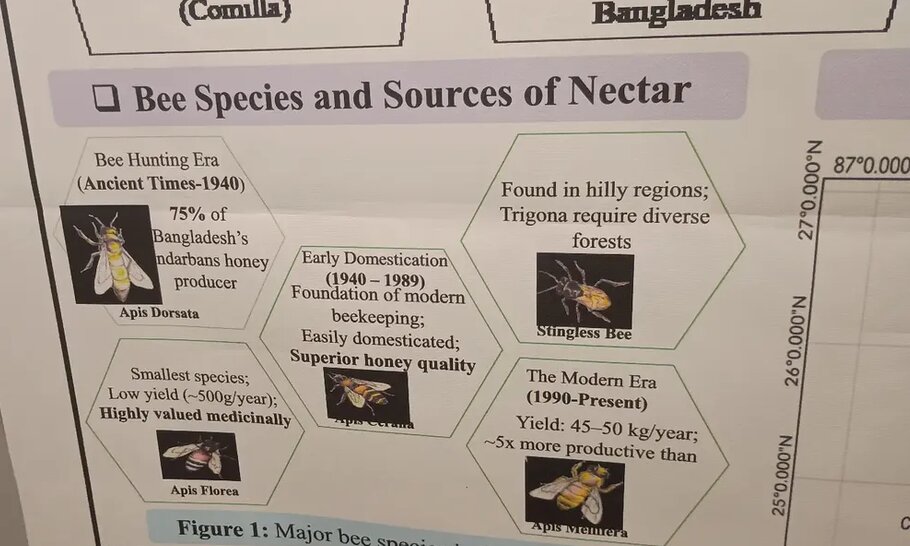
When I asked Syed Mohammed Mainul Anwar about it, he had an interesting perspective: you don’t need a lot of honey; it’s not a staple food. You need productivity for rice or wheat, but why would you need productivity for honey? You can just eat a teaspoon a day. In Bangladesh and Nepal, there seems to be a market for honey from native honey bees. Apis cerana honey is considered better quality there, and as such commands a higher price, making up for the lower productivity. So beekeepers making honey for the domestic market are incentivized to choose A. cerana, while those producing for export use A. mellifera.
Interestingly, the EU defines honey as produced by Apis mellifera bees, so honey from other bees, like Apis cerana or the giant and dwarf honey bees, can’t even be sold as honey there. To taste honey from Asia’s native bees, Europeans pretty much have to travel to where those bees live.
Native honey bees matter far beyond beekeeping, too. At the conference, Kedar Devkota gave a talk about a study he co-authored, published in Nature this year. Thank you, Kedar! I would not have known about it without your talk! The team followed 776 people in ten farming villages in Jumla, Nepal, for a year, recording what they ate, what they grew and earned, and which insects visited their crops.
Insect pollinators turned out to be directly responsible for 44% of the families’ farming income and more than 20% of their vitamin A, folate and vitamin E intake. The most important single species was the native eastern honey bee, Apis cerana: about 7% of the vitamin A people ate came from its pollination alone.
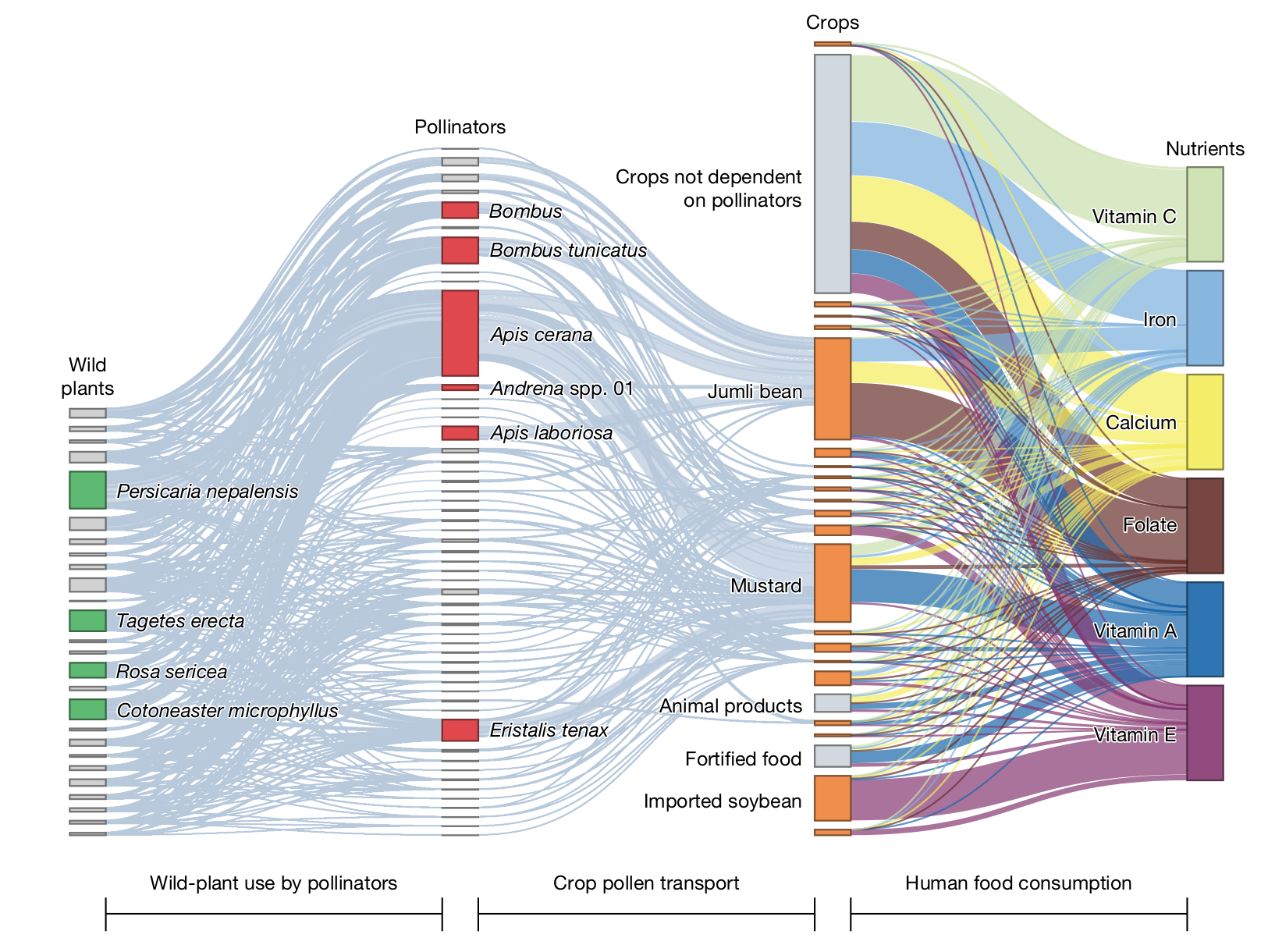
The figure reads from left to right: the wild plants that feed the pollinators, the pollinators carrying pollen between crops, and the nutrients people get from those crops. The large red bar in the middle is Apis cerana.
The worrying part is that beekeepers in these villages expect their Apis cerana to decline by a third between 2021 and 2030. Native bees are easy to overlook next to the western honey bee, but this study puts a number on how much people depend on them.
When we talk about protecting bees, what we actually need to do is to protect the native bees and pollinators. I’d love to help make or find a figure like the one above for Japan’s pollinators too.